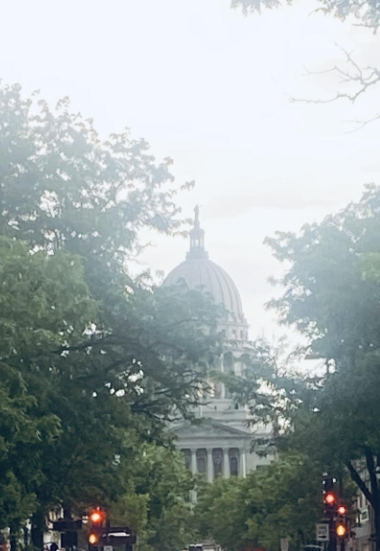

On Jan. 30, Madison community members gathered in the Library Mall before marching to the Capitol Building to protest Immigration and Customs Enforcement (ICE) operations in Minnesota. The rally was part of a larger full-day protest and general strike across the nation where participants did not go to work, attend school or spend money.
This was part of the organizers of the national protest’s decision to create a protest where participants refrained from all economic activity as a way of trying to disrupt daily operations of the Trump administration. The government gains money through taxes on almost all forms of economic activity, and it is common for major organizations to make political donations. The shutdown aimed to negatively impact the administration in order to make politicians listen.
Many local businesses closed for the day in solidarity with protesters; others closed early to accommodate employees who wanted to attend the rally or chose to donate a portion of their revenue for the day to charitable organizations.
The protest comes as a response to the recent substantial increase in ICE activity in Minneapolis, or what the Trump administration calls Operation Metro Surge. Speeches in the protest focused heavily on Renee Good and Alex Pretti, who were both killed by ICE agents in Minneapolis, as well as others across the country who have been killed by or died in custody of ICE.
As of now, Operation Metro Surge is coming to an end; the federal government has been cutting back on agents in the Minneapolis-St. Paul area and says it will be transitioning back to typical procedures operated by their local office. On Sunday, there were 1,000 ICE agents left in the twin cities.
The gathering was organized by local organizations Madison Socialist Alternative and Madison Area Democratic Socialist of America, and both groups brought featured speakers. It began around 2 p.m., and the march to the Capitol was slated to begin at 2:45 but was delayed by about 25 minutes due to a lack of power for sound amplification devices.
Organizers had planned on using power from the Memorial Library, but student organizations are required to submit requests to the Office of the Vice Chancellor before using sound amplification beyond handheld, battery-powered devices. Their power was cut by the university and they could no longer use their public address system, so they pivoted to megaphones.
The organizers of the local rally have not responded to requests for comment.