The Monroe Doctrine looks as if it’s still alive and well as the Trump administration takes increasingly gutsier moves into Latin America’s domestic politics. In mid-August, the US began deploying Navy warships and military personnel to the Caribbean; by Sept. 15th, Donald Trump had posted footage of an airstrike sinking an alleged drug smuggling boat and killing three men aboard the vessel. Following a second attack on Sept.16, Trump posted a threat to Drug Smugglers in all caps, “BE WARNED, IF YOU ARE TRANSPORTING DRUGS THAT CAN KILL AMERICANS, WE ARE HUNTING YOU!” The buildup of U.S. firepower in Latin America is the largest in over a generation, including the world’s largest aircraft carrier, the USS Gerald Ford.
President Trump opened the year promising to take control of Greenland, seize the Panama Canal and label several Latin American cartels—including MS‑13—as “foreign terrorist organizations.” He is ending it by launching airstrikes amounting in 83 deaths, offering $50 million for the arrest of Venezuelan Dictator Nicolas Maduro whom he has deemed a “Narco Terrorist” and suggesting a regime change in the region. Such actions all indicate a sharp shift in decades of U.S. foreign policy from cautious intervention, alliance-based diplomacy, and adherence to established international norms to a more unilateral, aggressive, and confrontational strategy in the Western Hemisphere. However, one leader in the region, Mexican President Claudia Sheinbaum, is asserting Mexico’s position amid Trump’s audacious moves.
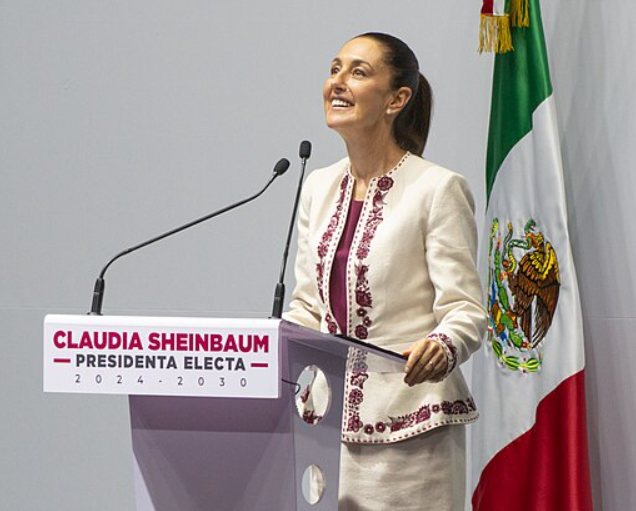
When Claudia Sheinbaum became president on Oct. 1, 2024, the first woman to ever govern Mexico, there were doubts about how she would handle Mexico’s relationship with the United States, especially if Trump won the election. A proud leftist and a climate scientist by trade, Sheinbaum had little foreign policy experience in her previous position as mayor of Mexico City. Despite these doubts, the two leaders have come a long way over the past few months, with President Trump even giving the Mexican president a sign of grudging respect: “You’re tough,” he told her in a phone call last March.
Early on, Sheinbaum’s rhetoric towards the Trump administration was, at times, adversarial. In the dawn of the Trump presidential electoral victory, Sheinbaum read out a pointed letter she had written to Trump responding to his threat of tariffs: “For every tariff, there will be a response in kind, until we put at risk our shared enterprises,” she said. Then, in early January 2025—after Trump announced that he would rename the Gulf of Mexico to the Gulf of America—Sheinbaum responded sarcastically that North America should be renamed “América Mexicana,” or “Mexican America,” because an 1814 founding document—written before Mexico’s constitution—used that term.
Still, despite Sheinbaum’s efforts to put on the “Hard Man Edifice” by making bold moves against drug cartels—the most notable being the extradition of 29 drug lords to the United States to face criminal charges— Mexico hasn’t been shielded from the Trump Administration’s unpredictability. The country faces a 25 % tariff on most items that do not meet the rules of the United States–Mexico–Canada Agreement, a trade deal that sets standards for goods and manufacturing across the three countries, as well as a 50% duty on steel, aluminum and copper produced in the country.
Yet Sheinbaum still remains steady through both American-led trade and political pressure. Most recently, on Nov. 18, Sheinbaum declined repeated offers from Donald Trump for U.S. military intervention on Mexican soil to combat cartel activity, ruling out any strikes against cartels in her country. This stance hasn’t been met without backlash, however; the idea of Sheinbaum being soft on the cartels has prompted widespread protests demanding security and government accountability. On Nov. 15, thousands of demonstrators organized by Gen Z youth groups marched across Mexico, resulting in a clash outside the National Palace in Mexico City that left over 100 police and 20 civilians injured, as protesters demanded stronger action against violence and called out Sheinbaum’s party for perceived inaction.