

If you are a high school student with a passion, participating in a summer internship is an excellent way to solidify your skills, grow your network and learn about what you enjoy. Finding an opportunity can be daunting if you don’t know where to start, but this guide will help you set yourself up for a successful summer.
Part 1: Getting Prepared
Don’t be fooled into thinking December is too early to begin your hunt for summer opportunities. Many companies who hire interns accept applications between November and February. Winter break is the perfect time to consider how you want to spend your summer, and with solid goals in mind, you can start applying and reaching out in January when people are less busy with the holiday season.
As you begin, consider your interests, skills, availability and what you hope to gain from the internship: experience, knowledge, payment, connections or something else?
Be cautious of over-specifying your hopes, because an internship that perfectly meets all of your criteria is hard to find and you may unintentionally limit your opportunities. However, it’s also important to be confident in what you want and seek positions that align with your goals.
Before starting your search, prepare a basic resume. Putting thought and intention into your introduction will prove your dedication as a high schooler and discourage people from dismissing you.
To create a resume, start by brainstorming what you have accomplished or participated in that involved skills applicable to your subject of interest. Consider past or current jobs, leadership roles, volunteer positions, extracurricular activities and more. Then, write concise descriptions explaining what you accomplished and learned in the position.
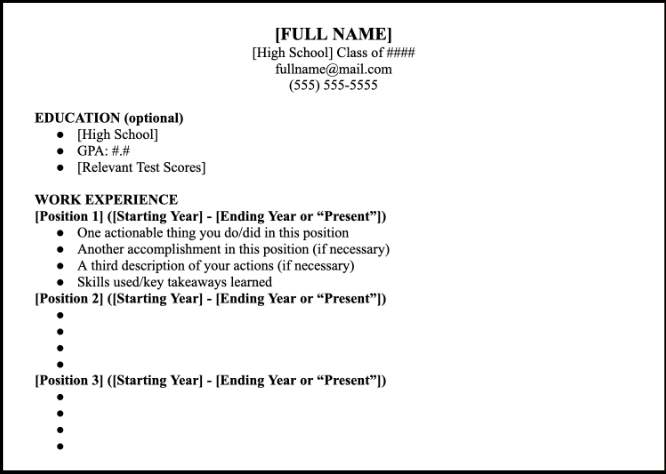
Don’t attempt to make your wording appeal to a specific employer yet — this resume is a starting point. As you submit it to different people or companies, you can send them each a tailored version to showcase your most relevant experience and prove your dedication to joining the community.
Other mistakes to avoid include oversharing personal information such as your home address or current income, inserting a photo or headshot and listing experience from before high school unless it is exceptionally impressive and relevant. In some cases, receiving a street address may help an employer. However, for an individual under 18 seeking an internship through networking and third-party platforms, omitting it initially is a safer option.
Along with your resume, think through how you will describe yourself with an elevator pitch, a brief self-introduction short enough to fit in an elevator ride. Whether in person or online, you should prepare to highlight who you are and how you define yourself. Here is a basic template as a starting point.
“I’m a [grade and high school] extremely passionate about [one or two subjects], and I love [experiences you enjoy (e.g. meeting new people)]. I’m seeking a summer internship where I can [summarize primary goals].”
After taking time to consider your objectives for the summer, you can shift your focus to finding the right internship for you.
Part 2: Finding Your Internship
There are two main ways to obtain internship opportunities: finding them and creating them. Many companies offer pre-existing internships, and where you look depends on your field of interest. Students looking to develop their scientific experience should consider research centers, local labs and university professors, and those interested in business and marketing can browse online directories of local businesses and nonprofits. People passionate about the arts should research local studios, venues and performance companies, and government-oriented students can look for programs associated with branches of their city or county government.
Regardless of your interest, many paths overlap, so widening your search to include several of these categories may help you discover unexpected opportunities. You can also browse websites such as LinkedIn and Indeed, but be sure to fact-check the openings you find on a third-party website.
As you research, look for pages on company websites with labels such as “Careers,” “Opportunities” or “Work With Us.” Be willing to spend time digging, as some companies offer internships more subtly, whether through an email address at the bottom of a subpage or an answer to a Frequently Asked Question.
As an additional strategy, follow groups of interest on Instagram, Facebook, LinkedIn or other social media platforms. Companies often create posts about open positions or internship applications, so staying up to date on their social media activity can give you a head start.
During your search for online applications, you can also work to create your own summer opportunities. The key to this strategy is willingness to fail; often, only a small proportion of your attempts will yield helpful–or any–results. However, when used with abundance and persistence, this strategy can lead to the most gratifying experiences.
Start by making a list of every adult with whom you have a positive relationship. This could include relatives, family friends or parents’ friends, teachers and mentors who know you well, past coworkers or people in your area of interest who you are connected to in some way. All relationships are different, so use your personal judgment to decide who it would be appropriate to message.
Then, reach out to the people on your list, each with a personalized and genuine message. Depending on your relationship with them, an in-person conversation, a text or a social media connection may be appropriate, but when in doubt, a short email will work for most interactions.
If you worked with the recipient previously and are unsure if they remember who you are, start with a message of appreciation for your past encounter. Transition to a written version of your elevator pitch, stating your name and summarizing your interests.
In a few sentences, explain that you are seeking a summer internship and politely ask if they either know of opportunities or can connect you with others in your field. If they don’t know you well or are more closely associated with a group you would like to work for, attach a copy of your resume. Avoid requiring your subject to review it, especially if you are not directly hoping for a job from them: most people are busy, and respecting their time with a short, low-pressure message will reflect better on you.
If you think the person you are reaching out to would be particularly helpful for your field of interest, you can also request a brief virtual or in-person meeting to discuss potential internships. Aim to send at least one email per day and, with consistency and patience, you will see new opportunities take shape. While many people will be unable to help, some will refer you to others, and your network will expand. With good timing, qualification and a lot of luck, you may even receive a direct internship offer.
Finding internships in high school can be challenging, but the benefit of the process is that your work will not go to waste. Even if your conversations don’t lead directly to an opportunity, you are still introducing yourself to countless people as someone eager to learn and ambitious about your future.
As you search, remember to be consistent and confident in your goals, and you will see your work pay off not only for your summer but for your future career.