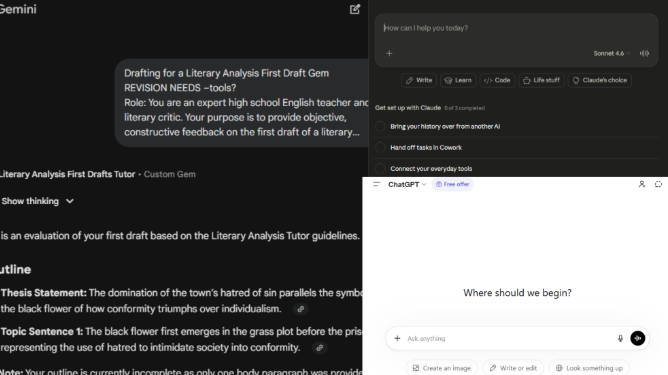
In the four years since the artificial intelligence (AI) chatbot ChatGPT was released in 2022 to the public, it has worked its way into many sectors of public and private life. From proofreading emails to processing data to writing entire essays, the novel opportunities in technological capabilities have spurred many to integrate AI into their lives in one way or another.
The progression of AI can be traced back to the 1950s, where Alan Turning, often referred to as the “father of computer science,” conceptualized AI. Since then, AI has sporadically appeared in various developments in technology, culminating most recently in the 2020 surge in development that released numerous chatbots for public use.
This new technology has initiated consideration about new advancements in a variety of fields, including reforming medical diagnostic processes and improving image recognition software. However, with any novelty comes controversy; for AI, one major instance is its role in education. With the ability to create cohesive outlines, solve complex problems and write detailed program code, the use of chatbots is becoming increasingly common amongst both teachers and students.
OpenAI, the AI research organization that developed ChatGPT, wrote in an article about mediating AI use in education that “helping students and educators cultivate powerful AI skills is one of the most important ways to ensure AI expands opportunity for all.”
Kris Cody-Johnson, an English teacher at Middleton High School (MHS), has started to cultivate these skills with her own students, integrating AI as a supplemental resource for classwork
“As a long term teacher, I know my students are going to be using AI, and also, for some of them, it removes barriers to learning that I have to concede are necessary,” Cody said.
Cody, who applied for a UW research experiment where they had teachers use AI in exchange for knowledge about how it was used in the field, said that she wants students to “dig in” and learn about how to use AI rather than just having it do the work.
On the other hand, Callie Geissler, a social studies teacher at MHS, is staunchly against AI, and aims to “de-center [her] life” from it despite the increasingly integrated use in daily life.
“I do not like how quickly it evolved and my biggest criticism and, quite frankly, fear comes from the environmental implications,” Geissler said. Her policy is simple: students aren’t allowed to use it, and class materials are fully AI-free.
“We all have beautiful, capable brains,” Geissler said. “The path of least resistance by using AI isn’t always the one that will foster our creativity and thinking skills.”
In her classroom, Cody allows students to implement AI as a way to bypass simpler tasks and focus on the aspects of critical thinking for various assignments. For one of the assignments in the MHS English course “Introduction to College Reading and Writing,” students are required to write a research paper based on a topic of their choice. Cody explains that AI allowed her to shorten the unit, giving students the opportunity to be more effective and efficient in finding sources.
However, students weren’t permitted to use AI on their summary, which Cody said gives them the opportunity to “master the material in order to write authentically and with confidence when the writing comes up.”
These benefits of using AI as a supplemental resource are corroborated by the results of a study with Carnegie Mellon graduate students, where researchers found that generative AI led to a 65% reduction in average writing time for both English and non-English speaking students. The students explained that it was most useful for “summarizing writing, and for general assistance in writing […] web research, policy development, and analysis.”
Geissler considers an alternate viewpoint: the overdependence of people on AI for critical thinking skills. “Collectively, I think we […] need to trust our instincts with problem solving,” she said. “AI can’t replace those abilities, but they can make us think we don’t need to use them.”
MHS computer science teacher Natalie Dykhuis also allows students to use AI in her classroom, where she encourages its use as a tool. “There’s problems where I just can’t see what’s happening,” Dykhuis said, referring to students’ program code, where AI is able to identify smaller errors that are harder to discern in large blocks of code.
However, both Cody and Dykhuis agree that there are limitations to using AI in classrooms, which inform their policies for how students are allowed to utilize AI in their assignments and work.
“I think of [learning] as a social activity, best done hands on, best done also through failures and experiment and grace. AI removes almost all of that,” Cody said, sharing that students are sacrificing the process of learning in favor of the efficiency that AI offers.
Dykhuis agrees, saying that “one of the biggest things that teachers will talk about is […] the productive struggle, where students just want the answer, and they don’t want to struggle to get to the answer. And I think AI feeds into that.”
Indeed, AI use among high school students has grown significantly over the past few years; the College Board found that from January to May 2025, reported AI use among high school students increased from 79% to 84%.
Cody also mentioned that the growing influence of AI on education has brought concerns about the accessibility gap between students, including whether students can take the risk of getting into trouble by using AI or not. The disparity in AI access has and will continue to be a factor in classes, she says, creating a divide in the classroom and comfort levels that impacts learning and culture.
Cody and Dykhuis both explained that their policies and approach to AI in the classroom are part of a broader shift towards embracing the integration of AI in education, which both regard as an inevitability.
“I would personally say it’s understanding how to use it to your advantage,” Dykhuis said. She compared AI to the 1990s release of the Internet, explaining that many teachers initially did not want to use it in their curriculums despite the widespread use that can now be seen in schools.
Internet access saw a significant increase in the classrooms during the 1990s, rising from 3% in 1994 to 87% in 2001. A similar increase can be seen in AI use by educators, with use reported to be 60% in the 2024-25 school year, only two years after mainstream public access to AI was facilitated.
“AI is in a very similar spot right now where eventually it’s going to be integrated into everything, and might as well embrace it now than be forced,” Dykhuis explained.
“What I see happening is […] we pivot more to handwritten, project-based, community-based, work,” Cody said, in regards to how AI would develop for the future of education.
With some of her classes’ assignments, Cody has formatted the critical thinking skills into a more arts-and-crafts, project-based approach, including the ‘accordion book,’ a montage of various prompts based on Toni Morrison’s “Beloved.”
Each prompt is interpreted by students through their own engagement with the book, displayed on two-page spreads of drawings and text. Cody said that the shift from the five-paragraph essay allows for better, more beautiful writing.
“I have to get my mindset to recenter myself and do the best I can,” Cody added. “Do the best I can [to] hold students accountable, and to teach the why, and then let things unfold.”