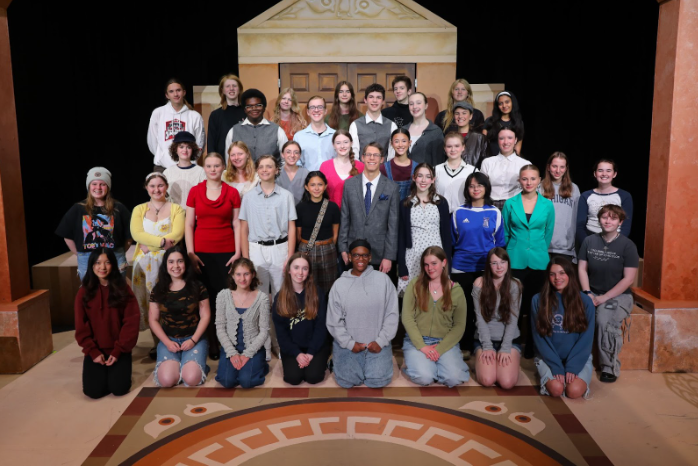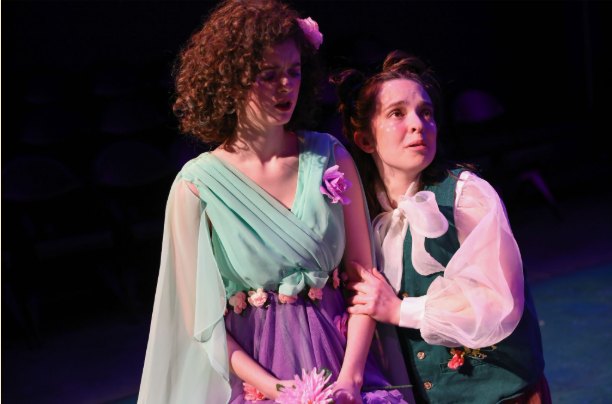

On Oct. 14, 15, and 16, Middleton High School (MHS) Theatre performed their emotionally vibrant production of the classic Greek tragedy “Antigone” in MHS’ Black Box theatre.
“Antigone” is a play written by Greek playwright Sophocles around 441 BC. Antigone acts as a sequel to another play written by Sophocles, Oedipus Rex. Oedipus Rex remains a popular play today compared to other works by Sophocles primarily because of the work of psychologist Sigmund Freud, who named one of his theories after the title character.
Oedipus, the main and title character of Oedipus Rex, becomes king of Thebes after the death of his father, and marries his mother. With her, Oedipus has two daughters, Ismene (Lila Elliott) and Antigone (Ailin Cobo Sanchez), and two sons, Polynices and Eteocles. When he discovers that he unknowingly killed his father at a crossroads dispute, he blinds himself and goes into exile with his two daughters, leaving the kingdom to be co-ruled by his sons.
Eventually Oedipus dies—the subject of another play by Sophacles—and his daughters return to Thebes. On return, Ismene and Antigone find that their brothers have died in a brutal civil war waged because both refused to yield the throne to the other. With Eteocles and Polynices dead, Oedipus’ male line is extinct; the crown is subsequently assumed by their matrilineal uncle Creon (Isaac Freiberg), who was previously the royal advisor.
It is arranged that Creon’s son, Haemon (Ian Tressler), will marry Antigone to strengthen the legitimacy of the new regime and gain the support of Ismene and Antigone, who still have a fair amount of influence and power over Thebes.
The play opens directly after Creon chooses to honor Eteocles, branding Polynices as a traitor in the wake of the civil war. Antigone, distraught by the fact that her brother was not granted funerary rights, is caught attempting to bury him in violation of an order by King Creon.
What follows is a series of emotionally vibrant scenes between the sisters, Creon, Haemon, and Eurydice (Magdalene Eklund)—Creon’s wife and Haemon’s mom—that make up the body of the play.
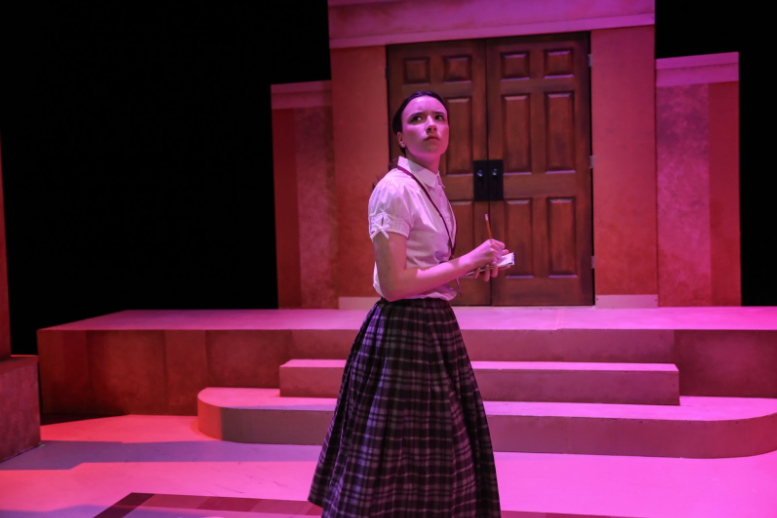
One unique aspect of “Antigone” and many other Greek tragedies is the presence of a chorus, a group of people who narrate by giving context and commentary. They act as a voice of the author, becoming a source of exposition and guiding the audience towards interpreting the message the author is attempting to communicate. At the beginning of the play, it also acted as a way to catch the audience’s attention, with various citizens of Thebes walking across the stage frantically in a building of chaos.
For “Antigone,” the composition of the chorus has changed over time to reflect a group that makes sense to the time. In the original play by Sophocles, the chorus is a group of male city elders. In this adaptation, the chorus is a broader group being various citizens of the city. In addition to narrating, the chorus is also shown to interact with other characters as well, including the opinions of the people when Creon becomes king.
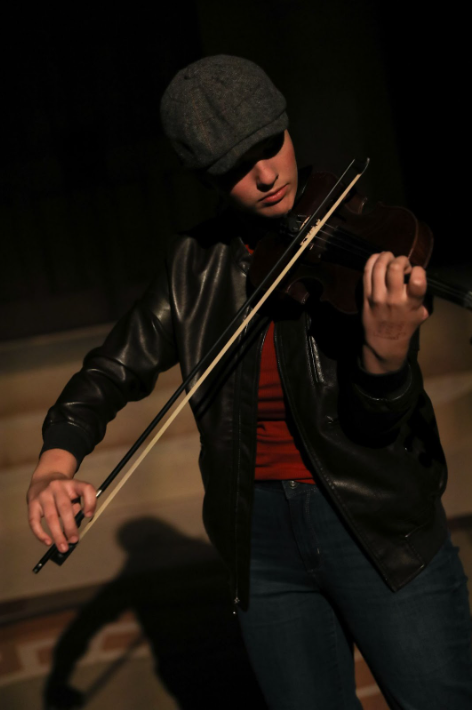
The chorus was one of the many great parts of MHS’ production, which also incorporated a blend of ancient Greek and English, themes, motifs, and stylistic elements. This was all completed with a modern cast and modern-day resources of a public schools theater program.
When asked about how this production was unique, Ian Tressler (Haemon) said that the “Greek [culture] in modern times […] made it tricky.” However, the theatre handled the challenge extremely well.
One of the most prominent ways that this element was brought out was the costuming. Because it wasn’t realistic for the program to purchase costly historically-accurate costumes, most of the characters dressed casually from their own wardrobes.
Instead of gaudy crowns as status symbols, the royal family of Thebes wore modern formal western attire to indicate their position in society. The guards are uniformed in dress shirts and pants, with vests instead of armor.
The pursuit of modernizing this ancient Greek tragedy made a complex story easier to understand for casual audience members, while balancing accuracy and respect to Sophacles’ original play. The beautifully expressive actors used these technical components to stun audiences, all supported by a flexible and adaptive crew.