
Videos and memes have recently been circulating around social media with the same caption: “Japan is turning footsteps into electricity. Using piezoelectric tiles, every step you take generates a small amount of energy.” The original creator of the caption remains unknown.
The question is, how exactly does Japan turn footsteps into electricity and for what purpose?
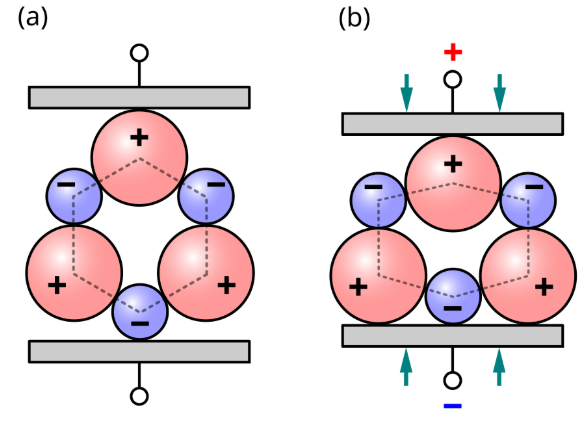
Piezoelectricity is the phenomenon in which the positive and negative charges within a material shift under mechanical strain or compression, creating tiny dipoles, or systems where one side holds a more positive charge and the opposite side holds a more negative charge. Materials that are piezoelectric—such as quartz and zinc oxide—often lack centrosymmetry, or a symmetrical structure, which allows for the electrical polarization. The charge separation when the compressed material is connected to a circuit creates a current from the electron flow.
Piezoelectric materials are being used more frequently in devices such as sensors, controllers, and actuators, which control mechanisms in machines and devices. Their accuracy, stability and sensitivity coupled with low energy consumption make piezoelectric materials a more efficient energy source compared to other similar sources such as electrostatic harvesters, which convert energy from sporadic sources into electricity. Studies have shown that piezoelectric materials may help in medical treatments such as tissue regeneration and cell proliferation through their electrical signals by mimicking natural bioelectrical signals.
Japan began to harness this power in October 2006. The direct piezoelectric effect, discovered by French physicist brothers Pierre and Jacques Curie in 1880, states that the amount of strain placed on the material determines the amount of voltage generated. In busy sectors of large cities in Japan such as Tokyo, Yokohama and Osaka, the ground faces significant direct force from constant foot traffic.
With energy resources becoming more essential than ever, Japan tapped into the power of these busy streets by installing piezoelectric tiles into sidewalks, streets, and public facilities. While various designs for piezoelectric tiles and flooring exist, civil engineering students at the Indira College of Engineering & Management constructed a design consisting of a concrete base, an acrylic sheet, nine piezoelectric sensors and a rubber sheet. The nine sensors were arranged in a grid upon the acrylic sheet, while the concrete base served to absorb vibrations and the rubber sheet was meant to prevent pedestrians from slipping. Their design performed well in testing, producing results that prove piezoelectricity might be the answer to renewable energy.
The East Japan Railway Company conducted a demonstration at Yaesu North Gate, Tokyo Station from Jan. 19 to March 7, 2008. The floor at ticketing stations and in stairwells was implanted with several discs constructed from piezoelectric materials that were all connected to the same circuit. Each day, the footsteps created by train passengers generated enough electricity to power a 100-watt lightbulb for 80 minutes. Though this might not be enough to power an entire city, progress is being made.
As more scientists worldwide push for the use of piezoelectricity, Japan is leading the movement by “turning footsteps into electricity.” More designs are being implemented worldwide, such as in the Kennedy Space Center in Cape Canaveral, Florida and Heathrow Airport in London. Each design is slightly different, but each location carries the same goal of utilizing any form of energy possible.