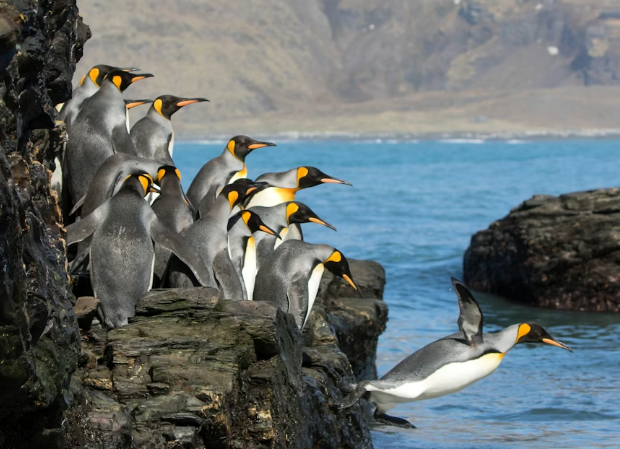
On April 9, the International Union for Conservation of Nature (IUCN) released an update to its Red List of Threatened Species. Among new classifications for other species, this press release declared the emperor penguin as Endangered.
According to The New York Times, scientists are aware of 66 emperor penguin breeding colonies in Antarctica. Collaborative assessments by the IUCN Species Survival Commission (SSC) Penguin Specialist Group and BirdLife International found that the emperor penguin population shrank by 10 percent between 2009 and 2018, translating to a loss of 20,000 penguins.
Because emperor penguin chicks are not waterproof, they use sea ice that is fastened to coastlines—–often called “fast ice”—–as a safe habitat to avoid drowning. However, the IUCN press release explained that climate change has caused Antarctic fast ice to break and melt more rapidly. Since 2016, sea ice has reached a record low and the IUCN concluded that rising temperatures caused by humans were the primary factor.
Fast ice now breaks earlier in the spring, and this offset schedule can threaten the lives of entire breeding colonies. The IUCN predicts that changes in melting patterns will halve the emperor penguin population by the 2080s.
Dr. Grethel Aguilar, IUCN Director General, insists that an ecological disruption this significant cannot be ignored.
“These important findings should spur us into action across all sectors and levels of society to decisively address climate change,” she said. “Antarctica’s role as our planet’s ‘frozen guardian’ is irreplaceable – offering untold benefits to humans, stabilising the climate and providing refuge to unique wildlife.”
Aguilar hopes that at the upcoming multinational Antarctic Treaty Consultative Meeting, this research will prove the urgency of reversing the damage of climate change in Antarctica. Along with emperor penguins, the Antarctic fur seal and southern elephant seal have recently been reclassified due to climate change.
The IUCN press release describes their process modeling populations in many future climate scenarios, and their findings show that “without abrupt and dramatic reductions in greenhouse gas emissions, emperor penguin populations will rapidly decline during this century.”
However, Xiao Cheng, Polar Research Center director at Sun Yat-sen University, was more hopeful. He told The New York Times that while the environmental decline in Antarctica is alarming, he has faith in emperor penguins’ natural resilience. Cheng recommended that people pair their action toward conservation with confidence in the species.
Emperor penguins’ reclassification shows the gravity of rising temperatures and ecological disruptions in Antarctica, but the species’ fate is not necessarily sealed. With dedication to conserving the ice and raising awareness about their protection, humans can help reverse habitat loss and rebuild a safe environment for future penguins.