More than 50 years after humans last set foot on the Moon, we are preparing to go back. The Artemis program will take place over several years in an effort to return humans to the Moon and establish a sustainable presence there. Led by NASA, the program aims to develop advanced spacecraft, spacesuits and life-supporting technologies capable of sustaining astronauts in deep space. These innovations are not just for lunar exploration; they are steps toward an even more ambitious goal: sending humans to Mars.
The Artemis program is different from past Moon missions. The goal of the Apollo program in the 1960s was to win the space race by putting the first man on the Moon and build excitement towards space exploration. Missions following Apollo 11 achieved a lot, but Artemis is aiming much higher. The program aims to establish a sustainable human presence on the Moon by using the resources found there. This includes building a base on the Moon to allow for long term lunar research and future missions to explore Mars.
There is still much more to learn about the Moon that can help our knowledge about Earth since the two formed from the same early solar system materials and share a connected history. However, the Earth erodes very quickly because of our weather system, so there is a lot we don’t know about the early years of the planet. Conversely, there is very little erosion on the Moon, with lunar rocks that are 4.5 billion years old. Studying these lunar rocks could tell us a lot about the Moon and Earth’s history.
There are five major missions in the Artemis program. The first was Artemis I, an uncrewed test flight launched in 2022. This 25-day mission used three mannequins, with one wearing a vest which measured solar radiation levels, to mimic a human crew and test safety. This test flight allowed NASA to see if the trajectory should be altered, if the heat shield worked when coming back down to Earth and tested communication in deep space. It also deployed small satellites called CubeSats to study the deep space environment.

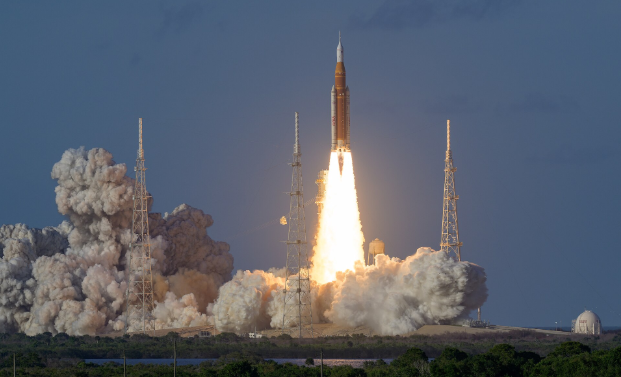
On April 1, Artemis II successfully launched from NASA’s space center in Florida, marking the first crewed flight beyond low Earth orbit since 1972. The ten-day mission was designed to test the spacecraft’s systems with astronauts on board, a critical step before future lunar landings. The crew—Reid Wiseman, Victor Glover, Christina Koch and Jeremy Hansen—traveled a total of 694,481 miles, venturing about 5,000 miles beyond the far side of the Moon and surpassing the distance record set by Apollo 13 in 1970.
Throughout the mission, the astronauts documented their journey from deep space. When flying by the Moon, they captured over 7,000 photos of the lunar surface and of a solar eclipse. They also observed lunar impact flashes, bursts of light produced by meteoroids or small asteroids hitting the Moon’s surface at high speeds, providing valuable data for scientists studying the Moon.

In addition to scientific work, the crew also drew widespread public attention. Many clips from the journey were popular on social media, such as a viral clip of a floating Nutella jar and interviews with the president of the United States and the prime minister of Canada.
Artemis II landed successfully, with all systems performing as expected. During reentry, the crew withstood speeds up to 25,000 miles per hour, setting yet another milestone for human spaceflight. These achievements further demonstrate NASA’s readiness to return humans to the Moon.
Artemis III, currently scheduled for 2027, will be the second crewed mission in the program. While it was originally intended to land on the Moon, delays and technical setbacks have shifted that goal to Artemis IV. Instead, Artemis III will now focus on testing Orion, the capsule meant to carry the astronauts in their journey’s docking capabilities in order to safely land humans on the Moon. Two private commercial landers were selected to be tested during Artemis III’s landing: SpaceX’s Starship Human Landing System and Blue Origin’s Blue Moon Lunar Lander.
Planned for 2028, Artemis IV is now expected to carry out the program’s first crewed landing and will last approximately 30 days. This mission has also undergone major changes. It was originally meant to deliver the Lunar Gateway station into lunar orbit. Gateway was meant to be a space station in the Moon’s orbit, and even though Gateway is mostly built already, NASA has now decided to repurpose Gateway for a $20 billion lunar surface base.
The astronauts will conduct a week-long mission on the lunar surface, where the crew will visit the Moon’s south pole to search for water, study the lunar surface and test their technology. The south pole is much colder than areas studied already, so there is a greater chance to find frozen water. Additionally, the Aitken Basin, the largest known crater on the Moon’s surface with a diameter of 2,500 kilometers, is close to the south pole and would give astronauts a variety of different rock layers to study.

Artemis V is planned to take place in late 2028 and will expand on what was completed through Artemis IV and will begin building NASA’s lunar base. They will also collect samples to continue research, deploy rovers and conduct field geology. Future missions are planned to take place once per year after Artemis V to continue research and work on the lunar base.
The Artemis missions represent more than a return to the Moon; they mark a turning point in how humans explore space. By building a lasting presence beyond Earth, scientists and astronauts will gain new insights into how life can survive and adapt in extreme environments. These discoveries will shape not only future missions, but our understanding of humanity’s place in the universe. As NASA pushes the boundaries of exploration, the Moon is no longer the final destination, but the starting point of a much larger journey.